Booking deposits in the UK: refunds, fees and fair cancellation terms
Learn how to take booking deposits legally in the UK, set fair cancellation terms and decide when to refund or retain fees, with advice for salons and clinics.

A booking deposit isn’t automatically yours to keep just because your policy calls it non-refundable. To understand how to take booking deposits legally in the UK, start with the fairness rule: consumer contract terms must be fair, and cancellation charges that are disproportionately high may be unfair under the Consumer Rights Act 2015. A blanket no-refund rule can be difficult to justify if your actual loss is small or the appointment is rebooked.
It’s reasonable to want protection from late cancellations and missed appointments. But customers should know the terms before booking, and any amount you keep should reflect the loss caused by the cancellation, rather than act as a penalty. You can also take booking deposits without a website.
This guide explains when you may be able to retain a deposit, how to set fair cancellation terms, and what to consider if you charge a separate cancellation fee. It also covers ways to take deposits without a website, so you can set a clear policy and give clients straightforward information before they confirm.
Key Takeaways
- Set out deposit and cancellation terms clearly before a client books, and make any retained amount reflect the loss caused.
- A non-refundable label alone doesn’t make a deposit fair; consider the timing of cancellation and whether the appointment can be rebooked.
- Keep deposit and cancellation charges proportionate, and account for VAT on retained payments where it applies.
- You can take booking deposits without a website, but a branded online booking page can make the process clearer and more organised.
Can I Charge a Cancellation Fee and Keep the Deposit?
Yes. A UK business can charge a cancellation fee or retain a deposit if the agreed terms are fair and clear. The amount should reflect the loss caused by the cancellation, not act as an automatic penalty.
Fair and Transparent Booking Terms
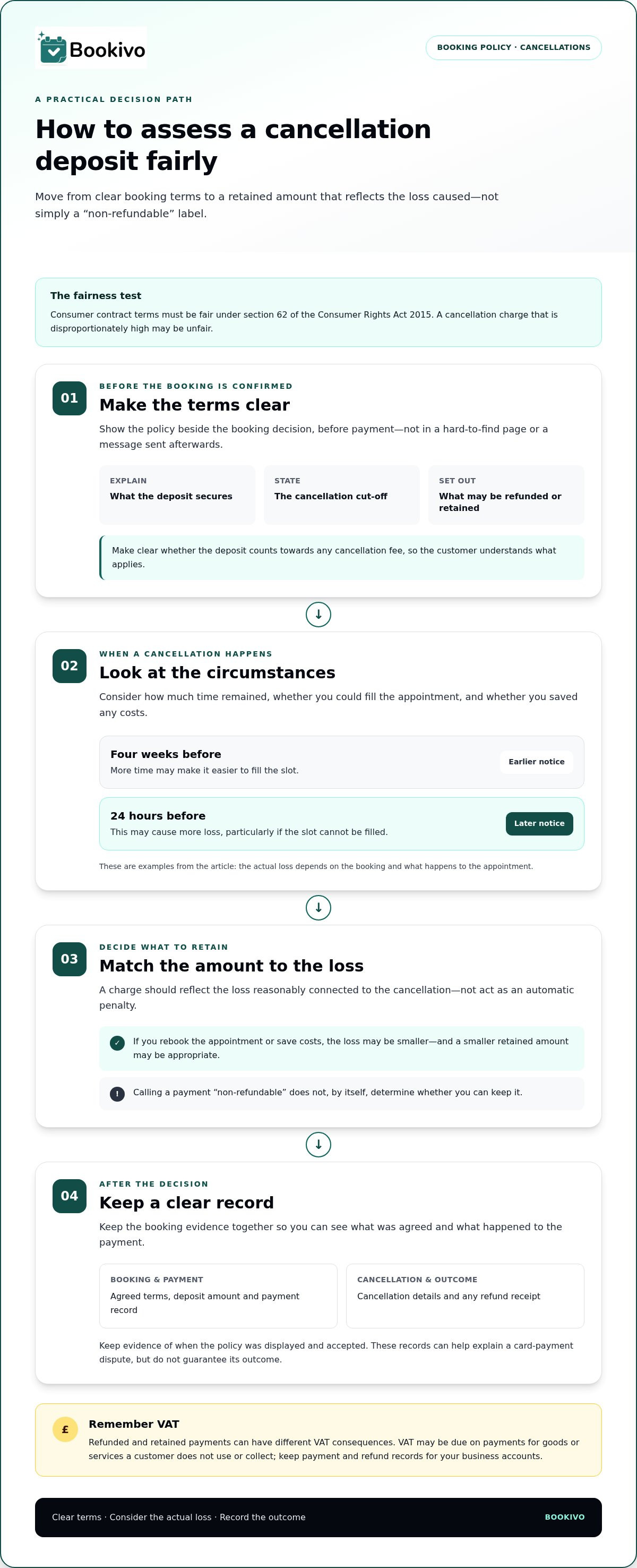
Fair booking terms explain the deposit, cancellation deadline and possible charge before a customer confirms. According to UK legislation, section 62 of the Consumer Rights Act requires consumer contract terms to be fair. Put the policy beside the booking decision, not in a hard-to-find page or message sent afterwards. For restaurants, deposit or no-show terms should be visible before customers confirm their booking.
Cancellation Fees and Retained Deposits
A cancellation charge should be proportionate to the loss you can reasonably connect to the missed appointment. For example, a cancellation 24 hours before a service may cause more loss than one made four weeks earlier, especially if you cannot fill the slot. Consider whether the appointment was rebooked and whether you saved costs; a smaller loss supports a smaller retained amount. State whether the deposit counts towards the fee, so customers understand what applies. For some business-to-business contracts, the Unfair Contract Terms Act 1977 and general contract principles may also be relevant. Set the amount and payment terms in writing, and make sure both parties accept them before work begins.
Payment Records and Unfair-Term Risks
For every booking, keep a dated record of the agreed terms, deposit amount, payment, cancellation and any refund. Use a secure payment method, such as a payment link, and never store card details or request them through unsecured email, text messages or written notes. PCI requirements apply to businesses accepting card payments through payment links, virtual terminals, card machines and phone payments. Hidden or misleading terms can prompt disputes, and an unfair term may be challenged. Don’t assume that a customer’s payment proves they saw or accepted your policy. Keep evidence of when it was displayed and agreed.
Can I make my booking deposits completely non-refundable?
A “non-refundable” label alone doesn’t determine whether you can keep a payment. Your policy should explain when a refund is due, how cancellations are treated and what happens to the amount paid.
Deposit and Refund Policy Wording
A clear policy tells customers what the payment secures and when it may be retained or refunded. Set out the terms alongside the booking details, before payment, and distinguish a deposit from a cancellation charge. For example, explain whether cancelling before an agreed cut-off means a full refund, partial refund or no refund. Clear wording helps customers understand the arrangement before confirming.
HM Revenue & Customs’ position is that VAT is due on payments for goods or services customers fail to use or collect from 1 March 2019. HMRC VAT Notice 700 also treats most deposits as advance payments, creating a tax point when received. A refund and a retained payment can therefore have different VAT consequences; keep payment and refund records for your business accounts.
Refunds of Holding Deposits
A holding deposit for a rental property is different from a salon or service appointment deposit. In England, a landlord or letting agent can take only one holding deposit at a time, capped at one week’s rent. The prospective tenant usually has 15 days to agree a tenancy, unless another period is agreed in writing.
In England, a landlord may keep a holding deposit if the tenant withdraws, gives false information or fails a right-to-rent check. If the landlord decides not to rent to them, the tenant should usually get it back. These rental rules don’t automatically determine refunds for booked beauty services.
Refunds and Chargebacks
A chargeback is a card payment dispute raised through the cardholder’s payment provider. Keep the booking confirmation, the policy shown at checkout, payment records, cancellation messages and any refund receipt together. These records help show what the customer accepted and what happened to the payment, but they don’t guarantee the outcome.
Never ask customers to send card details through unsecured email or text. A clear online booking page can show deposit terms alongside appointment information; see how a branded booking page could look.
Consumer Rights Act fairness and proportionate cancellation charges
UK rules on consumer deposits depend on the contract terms and type of booking. Fairness, cancellation timing and any statutory exception all matter.
Fair and Proportionate Cancellation Charges
Fairness means a cancellation charge should not impose compensation that is disproportionately high. UK legislation requires consumer contract terms to be fair under section 62 of the Consumer Rights Act. The Act doesn’t make every deposit automatically refundable; whether you can retain it depends on the term and circumstances. Publish clear wording before payment, such as: “Cancel by the stated cut-off for a refund.”
Explain what happens after the cut-off and how you calculate any amount retained. A written record of the agreed terms helps show what the customer accepted.
Cancellation Rights for Specific Bookings
Cancellation rights can differ between date-specific services and other online purchases. UK legislation gives consumers who buy online a 14-day cooling-off period, subject to exceptions. Regulation 28(1)(h) of the Consumer Contracts Regulations 2013 excludes date-specific catering contracts from the usual 14-day cancellation right.
For a restaurant booking on a particular evening, state the cancellation deadline and what happens to the deposit before confirmation. For appointments or bespoke services, don’t assume the catering exception applies. The relevant contract and service type matter.
Cancellation Timing and Reselling Tables
Cancellation timing affects the loss a business may face. A table cancelled early may be easier to offer to another customer than one cancelled shortly before service. If it is rebooked, the business’s actual loss may be smaller than if it remains empty.
For example, record when the customer cancelled and whether another party took the table. Apply the published policy in light of those details, rather than retaining an amount without considering what happened.
Rules Across Booking Types
Accommodation, events, appointments and bespoke services can have different terms and cancellation rights. The stated exception for a date-specific catering booking shouldn’t automatically be treated as applying to a hotel stay, salon appointment or custom service.
For each contract, identify the booking, deposit, cancellation cut-off and refund outcome. Explain any alternative offered, such as rescheduling, and keep the customer’s acceptance with the booking record. This makes the policy easier to apply consistently.
Legal ability to take deposits without a website in the UK
UK businesses can take deposits and part payments without a website. Understanding how to take booking deposits legally in the UK starts with agreeing clear terms and recording each payment and booking.
A salon can explain its deposit policy by phone, in person, by text or in a booking message. Before collecting payment, state which appointment it covers, the amount due, the cancellation terms and how refunds work. Ask the customer to confirm they accept the terms, then keep a dated record of that agreement. This makes the arrangement clear without an online booking page.
Choose a payment method that gives both sides a clear record. For example, you can match a bank transfer to a booking using the customer’s name and appointment date. You can also take a card payment without a website, using an appropriate payment method and handling card details securely. Don’t ask customers to send card details through unsecured messages.
Hotel reservations show how booking arrangements can differ. In the UK, customers booking directly or through an agent may be asked for card details to secure accommodation. A guaranteed reservation can reserve a room without taking payment at booking. Payment may be taken when the customer is due to arrive, and the hotel must keep the room rather than re-let it during the agreed period.
For a beauty appointment, include the terms in the message or receipt sent after booking. State the service, appointment date, deposit received and what happens if either party cancels. If a customer pays in person, give them a receipt or written confirmation. Keep the payment record with the booking so you can refer back to what was agreed if a question arises. This creates a clear, documented process for managing client deposits.
Bookivo: Beauty & Salon Booking Software
Bookivo provides beauty salons and aesthetics clinics with an online appointment booking system and branded booking website. Businesses can manage appointments, take deposits and process online payments through their own booking website. It’s a practical option if you want clients to book and pay online instead of arranging each deposit individually.
Set out your cancellation policy clearly in the booking process, so clients understand the terms before confirming. Bookivo supports the booking and payment workflow; setting fair terms remains your responsibility.
Visit Bookivo to explore whether it suits your booking process.
Make your booking process work for you
Make your deposit policy a consistent part of the booking journey. For a UK beauty business, understanding how to take booking deposits legally means more than choosing a payment method. Keep the terms visible, align them with your cancellation process, and make sure your booking records show what each customer agreed to. This gives you a clear process to follow for every appointment.
Bookivo offers Beauty & Salon Booking Software, Aesthetics Clinic Booking Software and an Online Appointment Booking System. These tools can support a more organised booking process, while you remain responsible for setting clear terms. Review the customer journey from the first enquiry through confirmation and payment to any later changes. This can help you spot confusing steps and decide what to improve.
Choose a booking process that fits the way you work, and keep your policy clear and consistent. A considered setup can help you manage appointments with greater confidence.
Frequently Asked Questions
Can a Business Keep a Deposit in the UK?
Yes, a business may keep a deposit when its terms allow it and retention is fair in the circumstances. For a beauty appointment, keep the booking confirmation and cancellation messages together. If a client disputes the deduction, these records help show which appointment the payment covered and how the stated policy was applied.
Deposit, prepayment or card hold: which mechanism should you use?
A deposit and a prepayment can both be paid upfront, so explain clearly what each payment covers. A card hold secures a booking without necessarily collecting money immediately. For example, a hotel may use card details to guarantee a reservation. Choose the option that suits whether you need to collect funds or secure a booking, and explain what the customer is agreeing to.
Do you owe VAT on retained deposits and no-show fees?
Retained payments and no-show fees can have VAT consequences for businesses that account for VAT. As an illustration, VAT on a retained £80 restaurant deposit is £13.33, leaving £66.67 net income. This is an example, not a universal calculation: the treatment depends on the transaction. Keep the original payment and booking records so the retained amount can be reconciled appropriately.
When can a UK business legally keep a booking deposit if a customer cancels?
A business may retain a deposit if its terms allow it and the amount is fair in the circumstances. If a client cancels a salon appointment, record the cancellation time and whether another customer booked the slot. These details help explain whether the business suffered a loss. Apply the policy to the specific booking rather than treating every cancellation as having the same financial effect.
How does the 14-day cooling-off period apply to bookings made online or by phone in the UK?
For a remote booking, keep a clear record of how and when the customer booked, along with any messages about the service. If they ask for the service to begin during a cooling-off period, record that request separately from their ordinary acceptance of the appointment. This gives both sides a clearer account of what was arranged and helps distinguish early performance from the booking itself.
What must UK businesses disclose about deposit amounts, cancellation terms and refunds before taking payment?
Before taking payment, show the deposit amount, what it covers, the cancellation process and how refunds are handled. Make the terms easy to find alongside the booking information, then keep a copy of the version shown to the customer. For online bookings, make sure the customer can review these details before final confirmation, rather than relying on a receipt sent afterwards.