Treatwell fees or flat-fee salon software: which to choose
Compare Treatwell fees for salons in the UK with flat-fee software. Learn how booking sources, account terms and team limits affect total costs before choosing.

A headline fee rarely tells the whole story. To compare Treatwell fees for salons in the UK, consider the costs of booking through a marketplace alongside flat-fee software and the terms that apply to your account.
It’s understandable to focus on the cost of each booking. A useful comparison also looks at where clients book, how software charges are structured and whether team limits suit your business. Assessing these factors together gives you a clearer basis for deciding.
This guide explains how to compare marketplace bookings with appointments made through your own website, review account terms and estimate costs using your records. It also covers team size and the trade-offs between booking-based charges and flat-fee software. Use these points to assess which arrangement fits your salon’s booking patterns and plans.
Key Takeaways
- Separate marketplace bookings from appointments made through your own website to compare the different cost factors.
- Review contract length, minimum commitments and cancellation terms before deciding whether an account suits your salon.
- Estimate total costs using your booking sources and sales, then consider how team-member limits may affect your plans.
- Use the decision guide to weigh a booking-based model against flat-fee software and choose what fits your business.
Table of Contents
- How do Treatwell fees differ for bookings made through its marketplace and a salon's own website?
- What contract terms, minimum commitments, or cancellation rules apply to Treatwell UK salon accounts?
- How can a UK salon estimate its total Treatwell costs from bookings and sales?
- Does treatwell
- Bookivo: Beauty & Salon Booking Software
How do Treatwell fees differ for bookings made through its marketplace and a salon's own website?
Start by separating appointments by booking source. A client who finds your salon through Treatwell’s marketplace follows a different route from someone who books through your website. To compare Treatwell fees for salons in the UK, match each booking to the charge basis in your account terms. Keep the channels distinct in your records before assessing which arrangement suits your salon.
For marketplace appointments, identify the charges that apply and how they’re calculated. Check the booking source, service value and any conditions in your account terms. Don’t assume every marketplace appointment carries the same charge. Map each fee to the relevant booking using your account documents, rather than applying one estimate to all appointments.
For website bookings, identify any software subscription, transaction charge or payment-processing cost. The specific terms affect your comparison. If a client pays a deposit online, for example, include any applicable processing charge. Assess Treatwell fees for salons in the UK alongside these website costs, not in isolation.
VAT affects the total, too. The UK standard VAT rate is 20%, according to HM Revenue & Customs. Establish whether each quoted amount includes VAT, then compare like with like. A pre-VAT charge and a VAT-inclusive charge are different totals.
- Separate marketplace bookings from website bookings in your records.
- Match each charge to its basis, such as booking source, service value or payment processing.
- Compare totals for the same period and on the same VAT basis.
Use the Treatwell alternative overview to consider how booking channels and account costs shape your comparison. Then compare those factors with your own account terms and the way clients currently book.
What contract terms, minimum commitments, or cancellation rules apply to Treatwell UK salon accounts?
Use your Treatwell agreement to establish your account’s commitment and exit terms. Don’t assume every salon account has the same contract length, minimum commitment or cancellation process. Your signed terms and any later amendments are the practical reference. Keep the relevant documents together so the person managing bookings can find them.
Review the agreement in order. First, find any initial term or minimum period. Then check the renewal wording, including whether the account renews automatically. Finally, note how to give notice, who must receive it and the deadline for ending the arrangement. Record these details in a calendar or contract register so the salon has a clear action point.
Cancellation terms involve more than a headline date. Check whether the agreement treats ending the software account separately from cancelling individual appointments, and note the steps required for each. If your salon plans to close its Treatwell account, establish how to give notice, when access ends and what happens to future bookings and account records. A client’s appointment cancellation policy is not the same as the salon’s contract exit process.
Read the clauses covering changes to fees, services or account access. Note how Treatwell will communicate changes and whether the agreement sets a response deadline or gives the salon a right to end the contract. Keep written notices and acknowledgements with the agreement. Dated records help clarify when notice was sent and which terms applied.
- Record the contract term, renewal wording and notice deadline.
- Separate salon account cancellation from appointment cancellation.
- Save Treatwell correspondence alongside the signed agreement.
If you’re comparing contract-based arrangements with a salon-controlled booking setup, picture your salon’s own booking experience and consider how it fits your preferred approach to managing appointments.
How can a UK salon estimate its total Treatwell costs from bookings and sales?
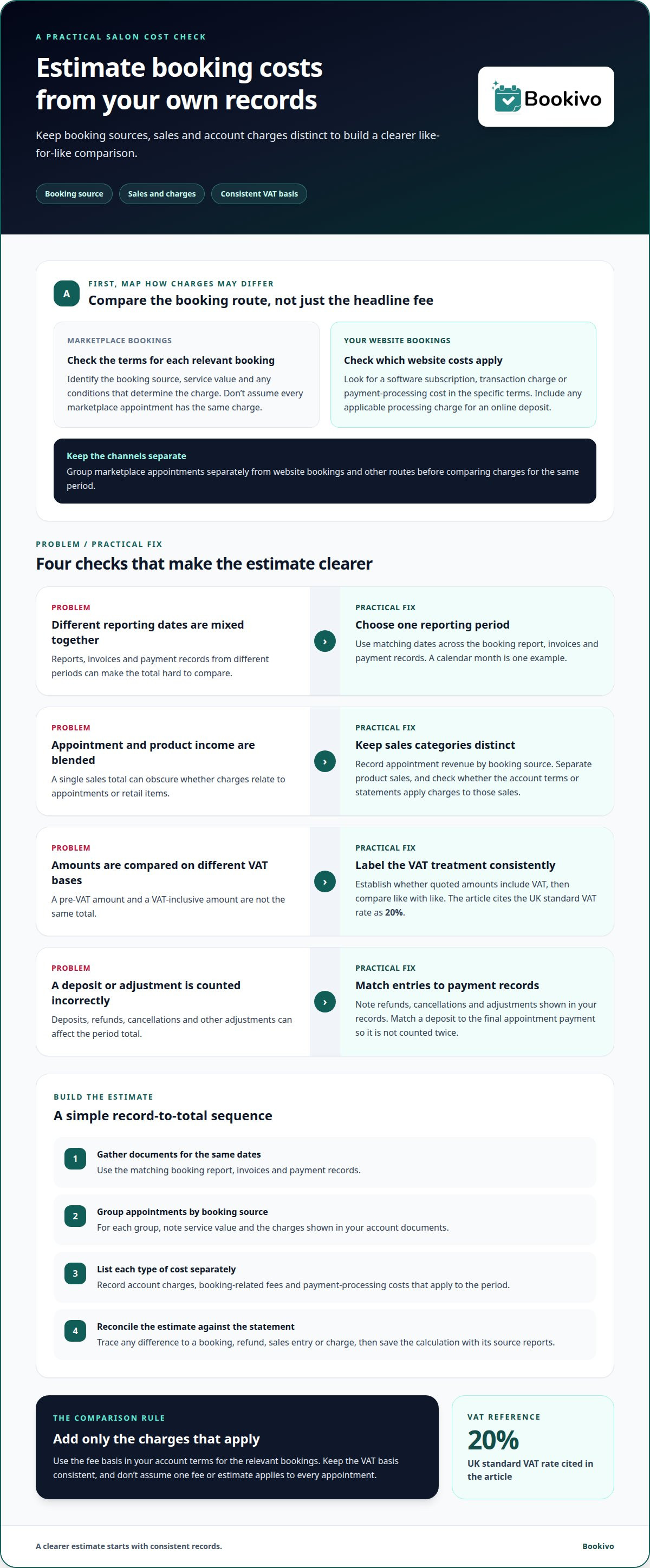
Choose one reporting period, such as a calendar month, and gather the matching Treatwell booking report, invoices and payment records. Use the same dates for every document. This gives you a consistent view of completed appointments, cancellations, payments and charges, without mixing figures from different periods.
Group appointments by booking source. Keep Treatwell marketplace bookings separate from appointments made through your website or another route. For each group, record the service value and charges shown in your account documents. Apply the fee basis in your Treatwell terms to the relevant bookings, rather than assuming one rate covers every appointment.
Review sales separately. If your salon sells products or adds retail items to appointments, identify those transactions in your sales records. Check whether your Treatwell terms or account statements apply charges to those sales, and include only charges for the period you’re measuring. This keeps product revenue distinct from appointment revenue.
- Record appointment revenue by booking source.
- List account charges and payment-processing costs separately.
- Separate product sales from treatment income.
- Note refunds, cancellations and adjustments shown in your records.
For a clear total, add the applicable account charges, booking-related fees and payment costs for the period. Keep VAT treatment consistent and label whether each amount includes VAT. Don’t count a deposit twice: match it to the final appointment payment using your payment records.
Reconcile your estimate against the Treatwell invoice and account statement. If the totals differ, trace the variance to a specific booking, refund, sales entry or charge. Save your calculation alongside its source reports. Using the same method each month makes it easier to compare actual costs as booking sources and sales patterns change.
Does treatwell
Whether Treatwell suits your salon depends on how its account charges relate to booking sources, team size and your booking mix. Don’t assume the same cost model applies to every arrangement. Compare the terms for your account with your appointment records, then assess the overall cost rather than focusing on one charge.
Team-member limits can affect the calculation. Check your account terms to see how staff are counted, whether each team member needs an individual profile and whether the plan sets a maximum. If you have several stylists, compare your active roster with the stated limit. As a solo professional, consider whether paying for unused team capacity affects the plan’s value.
For a fair comparison, use the same team size and booking period for each option. Record the number of active practitioners, the bookings each handles and the applicable account costs. Compare these with a flat-fee alternative, including any stated team limit or extra charge. A low headline fee may not suit a team that needs a different plan.
- Count the staff who need access, including part-time practitioners.
- Check how the plan defines an active team member.
- Compare the current roster with any stated limit.
- Recalculate if the salon plans to recruit or share bookings across staff.
Use your findings to decide what matters most: marketplace bookings, predictable software costs or flexibility to manage a changing team. A Treatwell account may suit a salon that values marketplace visibility, while flat-fee software like Bookivo can be easier to budget when team size and direct bookings are priorities. Compare the written account terms and team structure side by side before deciding.
Bookivo: Beauty & Salon Booking Software
Bookivo provides salons with an online booking system and branded booking website to manage appointments. Clients can book online, pay by card or Apple Pay, and leave deposits through your booking setup. This offers an alternative for salons that want to manage direct bookings through their own booking website, without marketplace commission.
Before choosing software, compare the features your team needs, how the booking experience represents your salon and how the costs fit your budget. Bookivo is designed for beauty and salon businesses that want their own booking website rather than a marketplace listing. Review the tools and consider whether they fit your workflow and team structure.
Visit bookivo.co.uk to explore Bookivo at your own pace.
Choose a booking setup that fits your next stage
Your booking system should support how you want to run and grow your business, not just how it operates today. As your team, services or balance of direct and marketplace bookings changes, revisit what you need from your software and how you want clients to book. Comparing Treatwell fees for salons in the UK can help inform your decision, but your daily workflow matters too.
Bookivo offers Beauty & Salon Booking Software, Aesthetics Clinic Booking Software and an Online Appointment Booking System. Explore these options if you want a booking setup shaped around your business and client experience.
Take the next step at your own pace. High-end aesthetics destinations like Devotion Beautique illustrate how a distinct brand identity and curated treatment menu shape the client journey; explore how a branded booking experience could suit your salon, clinic or independent practice, then decide whether it fits your plans.
Choose a booking setup that gives you clarity and control as your business moves forward.