Scaling a UK aesthetics clinic: lead costs and team growth
Learn how to scale an aesthetics clinic in the UK: track lead quality, improve bookings and plan team growth around capacity, from enquiry to treatment.

The cheapest enquiry isn’t always the most valuable. To understand how to scale an aesthetics clinic in the UK, measure lead costs against booked consultations and treatments, not enquiry numbers alone.
It makes sense to focus on what each lead costs. But a low-cost enquiry has little value if it goes no further, while a more expensive one may be worthwhile if it leads to a suitable treatment booking. Track where prospective clients drop out and whether your clinic can manage the demand.
This guide explains how to assess lead costs, improve the journey from enquiry to treatment and plan team growth around your clinic’s capacity. It also covers practical ways to strengthen your branding and help prospective clients understand your services. Clearer measures and consistent processes make growth decisions easier to assess.
Key Takeaways
- Assess lead quality by tracking enquiries through to consultations and treatments, not by looking at enquiry cost alone.
- Map each stage of the booking journey to see where prospective clients need clearer information or a more consistent response.
- Plan team growth around clinic capacity, with clear roles and processes to support a consistent client experience.
- Use clear, consistent clinic branding to help prospective clients understand your services and feel confident taking the next step.
1. What’s a good cost per lead for an aesthetic clinic?
Treat these as starting benchmarks, not a verdict on campaign quality. A lower cost per enquiry matters only if those enquiries become suitable consultations and treatments.
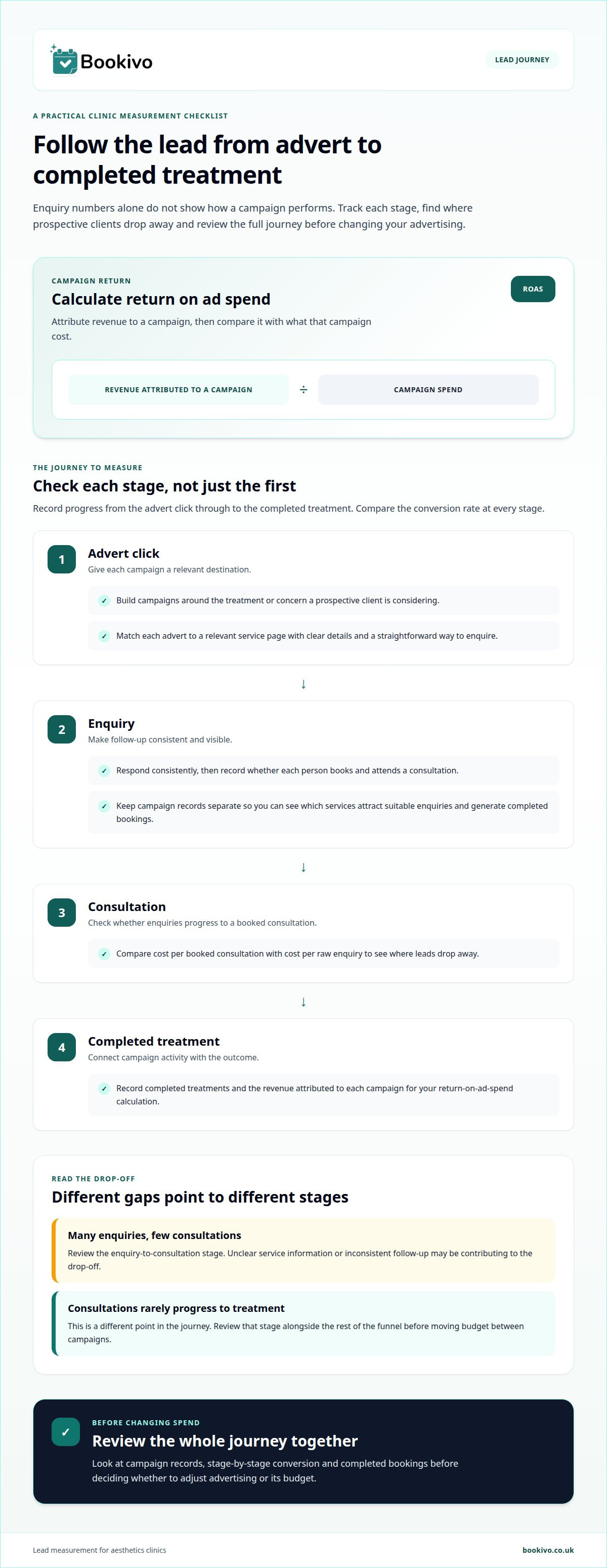
Track each stage separately: advertising spend, enquiries, consultations and completed treatments. A qualified patient matches your clinic’s criteria, wants a service you offer, and can be reached and is ready to talk. Compare cost per booked consultation with cost per raw enquiry to see where leads drop away. For example, frequent enquiries with few consultations may point to unclear service information or inconsistent follow-up.
Build local visibility with an accurate Google Business Profile, including your clinic’s location and service details. Use social media to explain your approach and answer common questions about your services. Invite satisfied patients to refer others, and make your details easy to share. Record referrals, local search and paid advertising separately.
Use a full-funnel approach. Match each advert to a relevant service page, respond consistently to enquiries, then record whether each person books and attends a consultation. Review the stages together before changing your advertising or increasing spend.
Patient identification belongs near the start of the enquiry and booking process. In England, administering botulinum toxin or cosmetic fillers by injection to anyone under 18 for cosmetic purposes is an offence under the Botulinum Toxin and Cosmetic Fillers (Children) Act 2021, according to UK Parliament. For UK home aesthetics clinics, the Environment Agency says waste transfer notes must be kept for at least 2 years.
Expanding an existing site can build on established local awareness; opening another location brings separate premises and local marketing needs. Franchising involves a different operating model, so compare control, staffing and consistency before choosing. There is no single expansion cost: premises, fit-out, equipment, staffing and marketing all shape the budget. Rules vary by location. The stated age-related offence applies in England, while permission for a home clinic can depend on the area.
2. Lead-to-treatment funnel and return on ad spend
Map the journey from advert click to enquiry, consultation and completed treatment. Compare the conversion rate at each stage, then calculate return on ad spend by dividing the revenue attributed to a campaign by its spend. Strong enquiry numbers but few bookings suggest a different problem from consultations that rarely progress to treatment.
Build campaigns around the treatment or concern a prospective patient is considering. Give each campaign a relevant landing page, clear service details and a straightforward way to enquire. Keep campaign records separate to see which services attract suitable enquiries and generate completed bookings. Review the full journey before moving budget between campaigns.
Locum work can sit alongside aesthetic treatments, but diary planning needs to reflect both commitments. Set availability around the practitioner’s actual clinic sessions, and keep each appointment type distinct in the diary. This helps the team see available capacity without treating every working day as an open treatment session.
Qualifications and professional expectations depend on the practitioner’s background, intended treatment and the relevant UK nation. Training should match the practitioner’s scope and applicable professional guidance; a foundation course alone doesn’t establish suitability for every procedure.
After foundation training, further learning should reflect the practitioner’s experience and intended treatments. Consider the required training pathway, supervision and insurer expectations before adding a service. Don’t assume one course title covers every filler or injectable treatment.
Room design also affects how reliably the clinic can deliver appointments. Plan a clear workflow for patient privacy, cleaning routines, equipment storage and staff movement. Assign responsibility for routine room checks and record completed tasks. A consistent setup gives each practitioner a practical space to prepare and work.
A well-organised branded booking journey can make it easier for prospective patients to move from service information to an appointment request.
3. Recruiting, onboarding and managing a team
Recruit for the capacity your clinic needs. Define each role before advertising, whether practitioner, consultation coordinator or clinic administrator. A clear job description should set out responsibilities, required experience and how the role supports patient care. During onboarding, explain booking procedures, enquiry ownership and how staff record follow-up. Consistent processes help new starters understand who responds when a patient asks about treatment.
Make lead management visible. Assign every enquiry to a named team member, record its status and set a clear next action. For example, a consultation coordinator can note that a prospective patient needs a call, then record whether it took place. A client management system can organise these interactions and reduce gaps during staff handovers. Review outstanding enquiries at team meetings.
Set performance measures that connect activity with clinic outcomes. Track enquiry response, consultation attendance, treatment bookings and rebooking patterns by practitioner or service. Discuss the figures regularly in one-to-ones, alongside client feedback and workload. Use trends to identify support needs, not just compare staff. A sudden fall in booked consultations, for example, may warrant a closer look at follow-up or diary capacity.
Clinic management software pricing depends on the functions included, team requirements and any charges for additional users or locations. Compare the full monthly figure with the tasks it supports, such as appointment records, client management and team calendars. Assess online booking platform pricing against the clinic’s operational needs rather than choosing on cost alone.
Before expanding, document how each new team member will be supported with booking procedures, enquiry ownership and follow-up. Regularly review outstanding enquiries and discuss workload and performance in one-to-ones. These routine checks can help the team maintain consistent processes as staffing changes.
4. Clinic branding and client acquisition
A clear clinic brand helps prospective clients recognise your service, understand its value and decide whether to enquire. Use a consistent name, visual style and tone across your website, Google Business Profile and social accounts. Keep your trading name, address and phone number consistent across those channels and Companies House listings.
Make key information easy to find. A prospective client should be able to identify what your clinic treats, who is clinically responsible and roughly what it costs within two minutes. Use clear service descriptions and dated prices, then review them regularly. Avoid unexplained treatment terms that leave people unsure what a booking involves.
Build search visibility around client concerns and services. Organise website pages around what people want help with, rather than prescription-only medicine brand names. Use relevant local details in each page, such as the clinic’s town and the service offered. Search optimisation takes sustained work; allow 6-12 months for an SEO strategy to build.
For paid advertising, separate campaigns by service and review the search terms report weekly. This shows whether adverts match the wording prospective clients use. Keep branding activity distinct from treatment campaigns, then compare enquiry quality and completed bookings. You can then see whether demand comes from your clinic’s reputation or a particular service.
Retention depends on the experience after the first enquiry. Give each patient clear service information, a consistent booking process and a straightforward way to return. Ask patients for reviews consistently, using the same approach each time. With permission and suitable processes, before-and-after photos can help present examples of your clinic’s work.
Review your brand through a prospective client’s eyes: can they recognise the clinic, understand its services and find a clear next step? A consistent identity makes every interaction, from search result to booking, feel connected.
Bookivo: Aesthetics Clinic Booking Software
Bookivo gives aesthetics clinics an online booking system and branded booking website, bringing appointment access and clinic presentation together. It can help clinics move on from separate manual booking processes and create a more consistent online journey for prospective clients.
A branded booking website gives clients a clinic-specific place to view booking options. An online appointment booking system can create a clearer route from discovering your clinic to requesting an appointment. These tools organise the booking experience; they don’t replace clinical judgement, training or governance.
If you’re considering a more joined-up booking experience, see what Bookivo could look like for your business. You can also Start your free trial.
Build your next stage around a clear decision
Growth doesn’t have to mean changing everything at once. Choose the next constraint to address, whether it’s booking administration, team coordination or the way prospective clients experience your clinic online. Make one practical change, then assess how it affects the way your business runs.
If you’re deciding how to scale an aesthetics clinic in the UK, the right systems should support your clinic’s work without adding unnecessary complexity. Bookivo offers Aesthetics Clinic Booking Software, Beauty & Salon Booking Software and an Online Appointment Booking System. Explore Bookivo’s options to see whether they suit your clinic’s needs.
Consider whether a more organised online booking process would support your next step. If so, explore Bookivo’s booking options for your clinic.
Take growth one considered decision at a time. A clear process gives you a stronger foundation for what comes next.
Frequently Asked Questions
How Do You Get Started?
Start by assembling a clear financial baseline for the clinic. Bring recent income, regular expenses, outstanding commitments and planned investment together in a cash-flow forecast. Separate recurring costs from one-off purchases, such as room alterations or equipment. This gives you a practical view of the working capital growth may require and helps you avoid committing funds needed for day-to-day operations.
What are the steps to scale an aesthetics clinic in the UK?
A practical approach to scaling an aesthetics clinic in the UK starts with a written business plan. Set out the clinic’s preferred direction, forecast income and expenditure, and compare each service’s contribution after direct costs. Then choose a growth route and set decision points for spending or investment. This makes the plan easier to adjust if demand, costs or available finance change.
What are typical UK aesthetics clinic revenue, profit margins, and treatment prices?
Typical revenue, profit margins and treatment prices vary, so a single figure would not describe every UK clinic accurately. Estimate revenue from services sold and appointments completed. Calculate profit by subtracting operating costs from revenue, then compare profit with revenue to understand the margin. When setting service prices, include relevant costs and the time involved, and review the result against your clinic’s commercial aims.
How should a UK aesthetics clinic hire practitioners and manage staff as it grows?
Use consistent, documented criteria to assess applicants, and structure interviews so candidates are evaluated fairly against the same requirements. Staff management should also include a realistic rota, regular opportunities to discuss workload and a clear route for professional development. These practices can support retention and continuity as the team changes, without relying on informal expectations or ad hoc conversations.
Is it better to scale a UK aesthetics clinic through extra locations, franchising, or a larger existing site?
Expanding an existing site can build on established local awareness. Another location brings separate premises and local marketing work, while franchising involves a different operating model. Compare control, staffing and consistency before choosing.
How do UK rules differ by nation for non-surgical cosmetic treatments and clinic licensing?
The material identifies an England-specific rule: injecting botulinum toxin or cosmetic fillers for cosmetic purposes in anyone under 18 is an offence. It also describes a UK licensing framework involving licences for both practitioners and home treatment rooms, but gives no further nation-by-nation comparison.